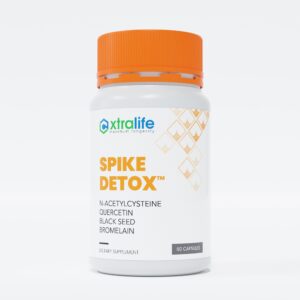
Spike Detox – One Bottle – 60 pill
Original price was: $74.75.$68.94Current price is: $68.94. inc GST1 bottle of 60 pills.


Since the early 17th Century, separation of church and state is a safeguard preventing any single belief system from controlling government power, a safeguard that allows the diversity of thinking that comes from integrating multiple perspectives.
When commerce enters science, we lose objectivity. Truth becomes trademark and we witness brand battles of proprietary solutions unfolding across a fractured landscape of polarised media, bought scholarship, and public institutions drifting and bending under the gravity of private power.
The recent USA ruling (Kory Vs Banta) echoes a truth COVID carved into history: when public institutions lean toward their paymasters, the doctor becomes the patient’s final refuge — a voice of independent science, second opinions, and healing traditions untouched by commercial gravity. This sets precedent and strong warning to other nations. Let’s take a look at our local situation in global context and how NZ could benefit from reform in this area also.

The COVID‑19 period revealed how fragile democratic processes become when medical authority merges with political power and when both are influenced by private global actors. The recent US ruling shows that governments have a responsibility to protect clinical independence and the patient’s right to impartial advice — whether that advice comes from conventional medicine, new experimental technology, natural health, or other legitimate disciplines. New Zealand must keep pace with emerging international standards and ensure that no single commercial or bureaucratic voice can dominate public health decision‑making.
Clear boundaries between medical interests and governing authority safeguard democracy, scientific integrity, and public trust. This is the foundation of a resilient, sovereign, and balanced health system.
COVID‑19 revealed a structural vulnerability in modern governance: the merging of political authority with medical bureaucracy, and the increasing influence of private commercial interests over both.
When medical agencies gain the power to override democratic processes — and when those agencies are themselves shaped by private funders — public health becomes exposed to conflicts of interest, policy capture, and emergency powers that bypass normal democratic safeguards.
New Zealand now faces a critical question:
How do we ensure that public health advice remains independent, evidence‑based, and free from commercial or political coercion?
A foundational answer is the principle of separation of medicine and state.
Concerns have been raised by former WHO and UN officials (see interview below) that the structure of global health governance has shifted dramatically over the past two decades, with over 80% of WHO’s budget now coming from voluntary, earmarked contributions — many from private foundations and public‑private partnerships rather than member states.
This funding model means donors effectively set WHO’s priorities, creating a culture where staff and policy direction align with the interests of funders rather than the diverse needs of nations.
Former WHO medical officer Dr David Bell has warned that this dynamic allows private actors — including pharmaceutical‑aligned organisations such as GAVI and the Gates Foundation — to influence WHO’s emergency declarations and recommended countermeasures, shaping global responses in ways that may reflect commercial agendas.
Former UN Assistant Secretary‑General Prof Ramesh Thakur similarly cautions that the combination of centralised authority and privatised influence risks overriding national sovereignty, as emergency powers and “international standards” can be imposed on domestic governments by unelected technocratic bodies.
These structural issues became visible during COVID‑19, where expert‑driven directives often displaced democratic decision‑making, prompting calls for countries like New Zealand to re‑examine how much authority over public health should be delegated to international organisations whose incentives may not align with national interests.
Primary references
• International Covid Summit III (ICS III), European Parliament, Brussels, 3 May 2023
◦ Panel featuring Dr David Bell
◦ Press conference featuring Prof Ramesh Thakur
◦ Both discuss WHO funding, sovereignty, and technocratic overreach
• WHO Programme Budget Reports (showing >80% voluntary earmarked funding)
During COVID‑19, the public was repeatedly instructed to “trust the science.”
But a critical question was rarely asked:
Whose science? And who funds it?
This concern is not fringe — it comes from the highest levels of medical publishing.
Medical journal editors have publicly warned that they have become “information laundries” for pharmaceutical companies.
Two of the most cited examples:
• Dr Marcia Angell, former Editor‑in‑Chief of The New England Journal of Medicine:
“It is simply no longer possible to believe much of the clinical research that is published.”
• Dr Richard Horton, Editor‑in‑Chief of The Lancet:
“Much of the scientific literature, perhaps half, may simply be untrue.”
These warnings highlight a systemic issue:
When the majority of clinical trials, medical education, and regulatory submissions are funded or authored by pharmaceutical companies, the boundary between independent science and commercial marketing becomes blurred.
This is precisely why separation of medicine and state is needed — not to weaken public health, but to protect it from conflicts of interest.
When medical bureaucracies hold the authority to declare emergencies, impose mandates, or override normal democratic processes, the integrity of those decisions must be unimpeachable.
But if the same bureaucracies are influenced by private funders — especially funders with commercial interests in vaccines, therapeutics, diagnostics, or surveillance technologies — then emergency powers risk becoming a mechanism for advancing private agendas under the banner of public health.
This is the core concern raised at ICS III:
• Emergency declarations can be shaped by funders
• Emergency countermeasures can align with commercial interests
• National sovereignty can be bypassed through international “standards”
New Zealand must ensure that emergency health powers cannot be influenced by private actors, foreign agencies, or international bodies whose incentives differ from our own.
Multiple whistleblowers, investigators, and former government advisors have raised concerns that gain‑of‑function research — experiments designed to enhance the transmissibility or pathogenicity of viruses — was conducted for years inside the United States under military or biodefense funding streams before restrictions were introduced in 2014. Congressional records show that when the US paused federal funding for such work, several research collaborations and subcontracted projects continued offshore, including at the Wuhan Institute of Virology, through complex networks of academic institutions, private contractors, and public‑private partnerships. Analysts such as Dr David Martin and authors like Robert F. Kennedy Jr. have argued that this reflects a deeper structural issue: the same institutions involved in biodefense research, pandemic modelling, and pharmaceutical development often share personnel, funding pathways, and strategic objectives. This does not imply wrongdoing; it highlights a governance challenge. When biodefense priorities, commercial pharmaceutical interests, and public health agencies become intertwined, the risk of policy capture increases — and democratic oversight becomes essential.
So the risk is not only the possibility that dangerous agents created in gain‑of‑function or biodefense research could leak (or indeed may have leaked) — though that concern has been raised in congressional investigations. The deeper risk is policy capture: when the same institutions involved in high‑risk research also influence public‑health policy, emergency declarations, and regulatory decisions. This structural overlap means commercial, military, or technocratic priorities can shape national health responses, reducing democratic oversight and compromising the independence of public‑health governance.
New Zealand’s regulators currently rely on international bodies such as ICMRA, WHO, SAGE, and ICH, along with data packages produced by the same pharmaceutical companies seeking approval. Even when independent academics are consulted, their evidence base still depends on academic journals and international regulatory science that have been heavily shaped by commercial interests — including the emergency‑era suppression of alternative treatments documented in US Senate hearings. This means much of our “independent” advice is imported from information streams already captured upstream.
Protecting sovereignty means more than safeguarding national decision‑making — it also requires protecting personal sovereignty, including the human right and indigenous right to choose traditional or natural health pathways. A local multidisciplinary council — including medical practitioners, natural health experts, Māori and Pasifika health leaders, independent scientists, and patient‑rights advocates — is essential to ensure New Zealanders have access to impartial advice, genuine second opinions, and culturally or scientifically grounded alternatives. Public health must serve the public, not private shareholders or foreign technocratic bodies.
Xtralife Health Science make natural health supplements, our flagship brand is Spike Detox, a New Zealand designed and manufactured supplement to support your body’s natural systems of protection and detoxification against ills and chills, including spike proteins, being the toxic residue from modern infections, injections or personal connections. Watch the video below and get a bottle or two for your cupboard for anybody struggling.
1 bottle of 60 pills.

3 bottles of